
1. General Introduction
In the storage, transportation and warehouse management industry, the organization of goods arrangement has always played an extremely important role. From manufacturing businesses to commercial and logistics units, storage performance not only affects operating costs, but also directly impacts the speed and quality of customer service. Among the many different storage racking systems – from selective pallet racks, drive-in racks to mobile racks – there is a “king” for bulky, oversized, and difficult to load and unload goods, which is the Cantilever rack.
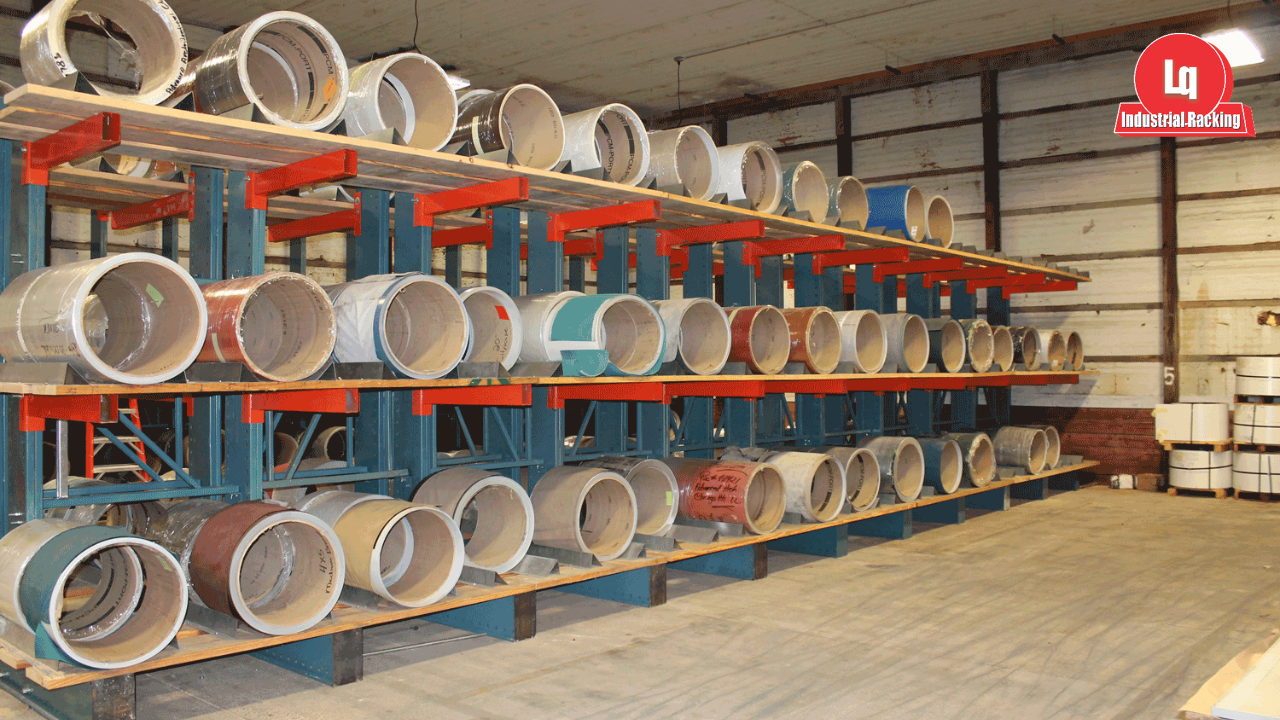
The Cantilever Rack stands out for its unique design: it only has key beams (support arms) to place and support goods, instead of using continuous shelves like most conventional pallet racks. Thanks to this unique structure, Cantilever shelves are ideal for storing long, heavy, bulky items such as steel pipes, wooden bars, boards, large-format fabric rolls, and even oversized furniture.
In this article, we will learn in detail about Cantilever shelves – from the mechanism of operation, advantages, precautions when using, to how to choose a reputable supplier. Thereby, it is hoped that it will help businesses or individuals have a more comprehensive perspective on this effective solution, as well as the practical applications it brings.

2. What is a Cantilever Shelf?
Cantilever shelves (also known as “key arm shelves” or “support arm shelves”) are shelving systems that are specifically designed to store long, heavy, or irregularly shaped goods. Unlike traditional pallet racks, Cantilever racks do not use horizontal beams to form a continuous floor, but instead have “arms” that extend outwards, directly to the uprights. This design makes the Cantilever rack “open” at the front, allowing forklifts or workers to access and load goods more easily.
A basic Cantilever shelving structure would include:
- Columns / Uprights: The main column bears the load and connects the supports.
- Base: Ensures stability for the post.
- Arms: The main unit supports the cargo, which can be customized in length, distance and tilt angle to suit each type of cargo.
- Braces: Horizontal or diagonal braces help to secure and increase the rigidity of the entire shelving system.
Besides, depending on the requirements and nature of the goods, Cantilever shelves can be designed with Single-Sided or Double-Sided configurations. In the case of side shelves, both sides of the pillar are fitted with supports, which makes the most of the storage space.

3. History of birth and development
Although today Cantilever shelves are commonly used in many industries, the idea of a protruding arm structure has been around for a long time in the field of architecture and construction. “Cantilever” bridges, balconies, and awnings have existed for centuries, taking advantage of the principle of leverage and fulcrum to create an “open” space below.
Around the beginning of the twentieth century, when the steel and transportation industry boomed, the demand for storing steel bars, metal pipes, wooden boards… began to increase sharply. Engineers, factories and logistics units need a new shelving solution that replaces traditional shelving that is bulky and unsuitable for storing oversized items. Since then, Cantilever shelves have been born as a “key” solution to help businesses optimize storage space, while increasing access to goods.
Over the decades, Cantilever shelves have gradually been improved in terms of materials (hot-rolled steel, cold-rolled steel, profiled steel), structure (quick-detachable, key-mounted, bolt-and-screw, etc.) as well as applying many anti-corrosion powder coating technologies, ensuring a long service life. Today, Cantilever shelves are present in almost every industry, from industrial production, logistics warehouses, building materials stores to furniture warehouses, mechanical workshops, etc.

4. Structural characteristics and principle of operation
4.1. “Open” structure
The biggest strength of Cantilever shelves compared to other types of shelves is the “open” structure at the front. Instead of having to thread the goods into a closed shelf, you can use a forklift or crane to place the goods directly on the handles. This makes the storage and export of Cantilever shelves more efficient, especially when it is necessary to handle items that are longer than the shelf depth, such as wooden slats 6-12 meters long.
4.2. Bearing principle
When a heavy object is placed on the support, the force is transmitted from the arm to the column and down to the base. At the same time, the braces will be subjected to tensile or compression forces, keeping the entire system from faltering. In order for the shelf to operate stably, the vertical post and stand must be designed to be large enough and thick enough to withstand the load; The links between the support arm and the post must be firm.
4.3. Load Allocation
During use, the operator should pay attention to the load distribution according to the manufacturer’s recommendations. Avoid concentrating too many heavy loads on the same support arm or on overhead shelves, as this can cause imbalance or affect the overall durability of the shelf.
5. Cantilever Shelf Classification
Cantilever shelves can be divided into many types based on different criteria, e.g. configuration (one side – two sides), load (light, medium, heavy), or construction material (cold rolled steel – hot rolled steel). Here are some common classifications:
5.1. Single-Sided Cantilever Shelves
- Characteristics: There is a support arm on only one side of the pillar, the other side is usually placed against the wall.
- Application: Suitable for warehouses with limited space, usually placed along the wall to take advantage of the area.

5.2. Double-Sided Cantilever Shelves
- Features: Each pillar can attach support arms on both sides, which doubles the storage space on the same pillar.
- Application: Put in the middle of the warehouse, suitable for large space. Optimized loading and unloading from both sides, especially useful for long, high-volume cargo.

5.3. Light Duty Cantilever Rack
- Characteristics: Using materials with thickness and smaller size, suitable for lightweight goods such as fabric rolls, plastic pipes, aluminum rods, thin wood, etc.
- Application: Furniture supply stores, small-scale factories.
5.4. Heavy Duty Cantilever Shelves
- Characteristics: Made of high thickness hot-rolled steel, large pillar height, strong support arm, use strong bolt link.
- Application: Steel plant, building material warehouse (shaped steel, concrete pipe, large wood, block stone…), heavy industrial warehouse, outdoor storage yard.
In addition, there are special versions of Cantilever shelves such as: mobile shelves (mobile Cantilever) or shelves with barriers or rubber pads at the end of the support to avoid scratching the surface of goods, automatic Cantilever shelves integrated with conveyor systems, etc.

6. Outstanding Advantages of Cantilever Shelves
6.1. Optimize space and reach
Thanks to the “open” structure on the front, the Cantilever shelf allows for faster picking and does not require too much handling space. When compared to conventional pallet racks, the ability to take advantage of the length of the goods is a huge plus: you don’t need to shred, disassemble or fold the rolls before storing them.
6.2. Storage of oversized and bulky goods
Steel pipes, wooden bars, MDF boards, plywood, plastic pipes, metal sheets, slate… all have an irregular shape. These products are difficult to fit into standard pallet racks. With Cantilever shelves, the solution of supporting goods with a key arm helps to spread out the contact surface and support it firmly, ensuring safety.
6.3. Flexible in use
Cantilever shelves can customize the length of the supports, the distance between the floors, and even change the shelf configuration from one side to two sides (in some designs). Thanks to this flexibility, businesses can proactively upgrade when storage needs change.
6.4. Large load capacity
When using high-quality steel and correctly calculating the load, a single row of Cantilever shelves can support tens of tons. In addition, the arrangement of cross bracing rods will help enhance stability and ensure long-term safety.
6.5. Easy to install and maintain
The majority of modern Cantilever shelves are modular in design, using bolts, screws and mounts, making assembly and dismantling quick and time-consuming. If you plan to relocate your warehouse or relocate your warehouse, Cantilever shelves can be moved and reinstalled easily.

7. Application of Cantilever Shelf in Practice
7.1. Wood and furniture industry
In lumber workshops, warehouses for wooden boards, MDF or solid wood panels are usually large in size, 3-6 meters in length, or even more. Cantilever shelves help to stack these wooden panels neatly, which can be arranged by thickness, wood type, or specification.
7.2. Building Materials Warehouse
In stores and supermarkets of building materials, we often see long PVC pipes, steel bars, roofing tole sheets… The use of Cantilever shelves not only increases storage space, but also makes picking up goods quickly, avoiding product scratches.
7.3. Mechanical Engineering and Manufacturing
Shaped steel (H, I, U, V, L), steel pipes, mule bars, cables… are all bulky products, difficult to load and unload. Thanks to Cantilever shelves, mechanical workshops, machine manufacturing, and shipbuilding can classify components and materials by length, which is convenient for the production process.
7.4. Automobile, agricultural machinery
For large-sized auto parts (trunks, car bodies), agricultural machinery accessories (wipers, metal frames, etc.) can also be stacked on the supports of Cantilever shelves, which is both safe and easy to check the quantity.
7.5. Logistics and warehousing industry
Besides Selective, Drive-in racking, Cantilever shelves are used by logistics companies in large distribution centers and container yards to store oversized packages. With modular design, these companies can quickly adjust the shelf structure to suit each season or type of goods.
8. Economic benefits and warehousing strategy
8.1. Increase efficiency and reduce labor costs
Thanks to faster loading and unloading, Cantilever shelves help to minimize time and effort during the inbound and outbound process. This means that businesses can significantly save labor costs and increase operational efficiency.
8.2. Optimal use of warehouse space
With long or large-format items, without Cantilever shelves, they often have to be placed on the floor or need a complex type of custom shelf. This solution takes up a lot of space. When using Cantilever shelves, you can stack multiple floors, taking advantage of warehouse height, thereby increasing the overall storage capacity.
8.3. Protecting the quality of goods
For goods that are easily dented and scratched such as metal sheets, wood, plastic pipes… Cantilever shelves help keep them neatly on the support, limiting collisions with other hard surfaces. Better protection of goods will reduce losses and damage.
8.4. Create professional images
In the building materials or furniture business, a neat and professional warehouse space will create trust with customers, increasing the reputation of the brand.
9. Experience in installation and selection of Cantilever shelves
9.1. Determination of load and size
Before placing an order, it is necessary to estimate the total weight of the goods, length, width, and height of each item to calculate the number of floors, number of support arms, support arm length, and pillar thickness. Small errors in this calculation can also affect durability and safety during operation.
9.2. Material selection
For oversized, heavy goods (e.g. sheet steel, large block wood), it is recommended to choose Cantilever shelves made of hot-rolled steel, high thickness and bearing capacity. For light goods or not too harsh environments, cold-rolled steel or powder-coated profile steel is enough to meet the demand, saving costs.
9.3. Link Type
Cantilever shelves typically use two main types of bonding:
- Bolts – screws: Easy to remove, flexible to change configurations, but take more time to tighten screws.
- Mounts (or hooks): Quick installation, but it is necessary to choose the right type of mount with a secure locking mechanism, ensuring good load.
9.4. Taking into account environmental factors
If the shelf is placed in a humid environment, outdoors, or exposed to chemicals, it is recommended to give preference to the type of shelf with thick powder coating, or hot galvanized to resist corrosion. In addition, it is necessary to ensure that the warehouse floor is hard enough, bears a good load, and avoids subsidence that can tilt the shelves.
9.5. Choose a reputable supplier
Currently, there are many manufacturers and importers of Cantilever shelves on the market. To avoid “losing money”, choose an experienced supplier, have a certificate of material quality, and have a team of engineers to support the design and survey of the warehouse.

10. Safety precautions and operating procedures
10.1. Employee Training
Regardless of Cantilever or conventional pallet racking , the risk of warehousing accidents is always latent. Training staff on how to load and unload goods, how to use forklifts, and rack load testing is crucial.
10.2. Periodic check
Cantilever shelves bear heavy loads and are often exposed to lifting and impacting processes. Therefore, it is necessary to schedule periodic inspections (usually quarterly or semi-annually): check bolts, welds, tilts, curvature of the supports, etc. If damage is found, it should be repaired or replaced immediately.
10.3. Scientific Cargo Arrangement
To ensure safety, it is best to order the heaviest goods on the lower floors, light or short goods on the upper floors. Do not let the goods exceed the length of the support arm too much, avoiding imbalance.
10.4. Signage and Load
Each row of Cantilever shelves should have a sign clearly stating the maximum load for each floor, each support. Employees need to comply absolutely to avoid overloading, leading to deformation or collapse of the shelf.
11. Development and improvement trends
With the development of Industry 4.0 and the trend of automation in warehouses, Cantilever shelves are also being integrated into automated or semi-automated systems. For example, some modern warehouses use automated forklifts (AGVs) or smart racking systems, which allow for flexible handling, management, and inventory of goods and limit manual labor.
In addition, manufacturers are also researching many solutions to help protect the environment and increase sustainability, such as the use of recycled steel, the application of lead-free powder coating, or the design of shelves that can be reused for many purposes.
12. Conclusion
Cantilever shelves deserve the title of “Lord of Bulky Goods” thanks to their versatility, space optimization and special suitability for long, large, high-weight products. It is an almost irreplaceable option for industries and trades that need to manage oversized goods.
In addition to the economic benefits, Cantilever shelves also help businesses build a neat and professional warehouse image; minimizing occupational risks and accidents; at the same time, improve the quality of services for customers and partners. However, in order for the shelf system to reach its full potential, businesses need to focus on designing, installing, maintaining and training employees thoroughly.
If you’re looking for a storage shelving solution that is both durable and flexible for long, heavy, irregularly shaped items, then Cantilever shelving is one of the top choices. Through this article, we hope you have an overview, as well as grasp the important principles in choosing, using and maintaining Cantilever shelves.
Contact Information
HOT LINE:
0903422179 (Mr. Dat)
0903412296 (Mr. Hien)
0903434374 (Mr. Cam)
EMAILS:
contact@giakelongquyen.com
contact@longquyen.com
OFFICE:
79 Dao Tan St., Giang Vo Ward, Ha Noi, Viet Nam
84-24-37260098; Fax: 84-24-32115955
FACTORY:
1085 Phuc Dien St., Xuan Phuong Ward, Hanoi, Vietnam
84-24-37643527; Fax: 84-24-37643767
[wpforms id=”119062″]


