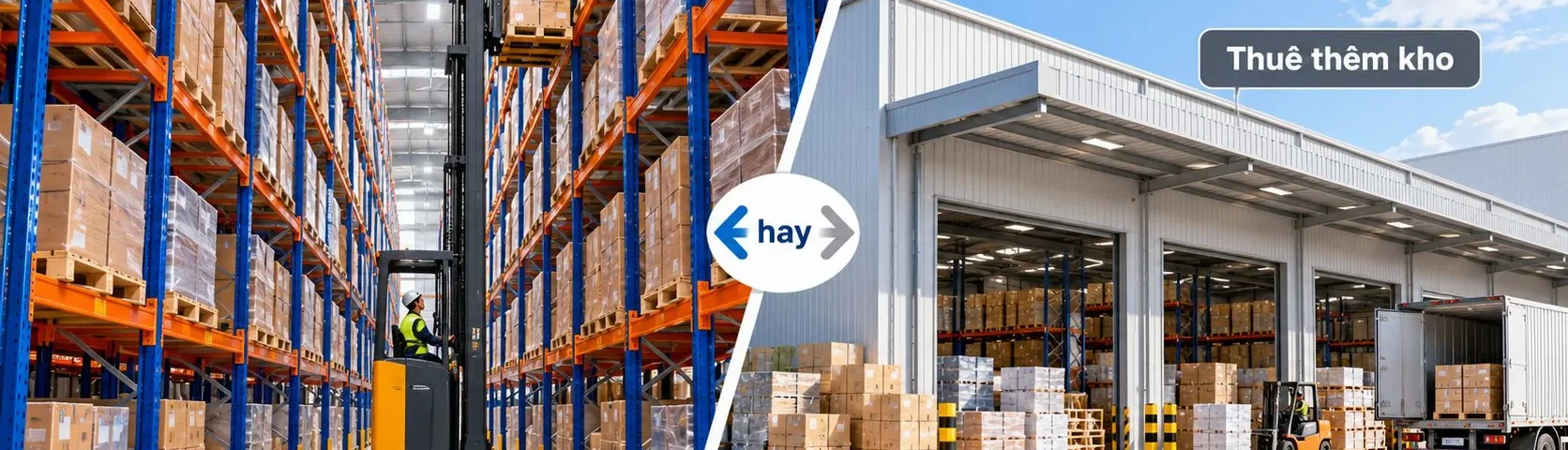
Investing in high-bay racking usually pays back faster than leasing more warehouse space when your current building has a clear height of 8 m or more and storage demand will stay stable for the next 2–3 years. Conversely, leasing extra space makes more sense when demand spikes only in the short term, or when the existing ceiling is below 6 m and cannot take high-bay racking without structural modification.

Key takeaways
- High-bay racking (VNA, Radio Shuttle, Mobile Rack) uses height instead of floor area — the same warehouse floor can gain significantly more pallet positions if the ceiling is high enough.
- Publicly listed market prices for VNA racking: about VND 700,000 – 1,200,000 per pallet position; Radio Shuttle: VND 1,200,000 – 2,200,000 per pallet position (source: Vinatech Group public price list, 2026).
- Average rent for ready-built warehouses in northern Vietnam is USD 4.5/m²/month according to JLL’s H1 2026 report — a recurring annual cost, fundamentally different from a one-off racking investment.
- The break-even point between investing in high-bay racking and leasing more space usually falls at around 2–4 years, depending on actual utilisation and rent fluctuations.
- Must-check conditions before deciding: clear ceiling height, concrete floor load capacity, and the type of specialised forklift you will need to invest in.
What is high-bay racking?
High-bay racking is a pallet racking system that uses warehouse heights of 8 m and above — typically Very Narrow Aisle (VNA), Radio Shuttle or Mobile Rack — to increase storage positions on the same floor area without expanding land or leasing additional space.
Unlike standard selective racking (usually 5–6 m high with 3–3.5 m aisles for reach trucks), high-bay racking narrows aisles to 1.6–1.8 m (VNA racking) or eliminates fixed aisles entirely (Radio Shuttle, Mobile Rack) to dedicate floor area to vertical storage. This is essentially an extension of the question of how to calculate warehouse pallet capacity once floor space has reached its limit. In return, the system requires specialised forklifts, a flatter concrete floor with higher load capacity, and enough clear height under the roof structure.
6 technical points to know before investing
1. Use height instead of land area
Land cost and building envelope cost (roof, walls, floor) per m² are almost fixed, while extra warehouse height can be used with virtually no additional land cost. That is why high-bay racking usually delivers better ROI in areas where land and warehouse rents are rising.
2. Narrow aisles increase storage density
Aisles for standard reach trucks are 3–3.5 m wide; VNA forklifts (turret trucks) need only 1.6–1.8 m. The space saved by narrower aisles becomes additional storage racking.

3. No new land or warehouse rental costs
Racking is a one-off investment (CAPEX); leasing more space is a recurring monthly cost (OPEX) that usually rises over the lease term — JLL’s H1 2026 report notes that industrial land rents in northern Vietnam keep increasing as ready-to-build land in strategic locations becomes scarcer.
4. Specialised forklifts are mandatory
Ordinary reach trucks cannot operate in VNA aisles. Companies need to buy or rent VNA/turret trucks, or a semi-automated Radio Shuttle system — an additional cost that must be included in the total investment, not just the racking cost.
5. Higher floor and ceiling requirements
High-bay racking puts heavy loads on smaller base plates than selective racking, requiring a concrete floor with higher point-load capacity and stricter flatness (especially for VNA, where tolerances are measured in millimetres along the whole aisle). The roof structure also needs sufficient safety clearance above the racking under fire-protection standards — see the allowable deformation limits for racking in operation in our article on warehouse racking damage.
6. Installation can be done zone by zone
For operating warehouses, Long Quyen usually installs zone by zone so that inbound and outbound operations do not have to stop across the whole site — one of the most common practical requirements from customers expanding an existing warehouse rather than building a new one.
Technical specifications by high-bay racking type
| Racking type | Usable height | Forklift aisle | Forklift type | Load per pallet position |
|---|---|---|---|---|
| Standard selective (baseline) | 5 – 6 m | 3.0 – 3.5 m | Reach truck / standard forklift | 500 – 1,500 kg |
| VNA (Very Narrow Aisle) | 8 – 14 m | 1.6 – 1.8 m | Turret truck | 500 – 1,200 kg |
| Radio Shuttle | 8 – 12 m (per block) | No aisles needed between blocks | Forklift loads the shuttle at the end of the lane | 800 – 1,500 kg |
| Mobile Rack (mobile racking) | 6 – 10 m | 1 travel aisle for the whole run | Reach truck | 500 – 1,200 kg |
The table above shows typical technical specifications from industry literature (see Interlake Mecalux — VNA pallet racking), and does not replace project-specific structural drawings. Actual height and load capacity always depend on a survey of the ceiling, floor load capacity and the pallet types used at each plant.
Comparison: invest in high-bay racking, lease more space, or expand the building?
| Criterion | High-bay racking investment | Lease more space | Build an extension |
|---|---|---|---|
| Nature of cost | One-off CAPEX | Monthly OPEX, rising over time | Large CAPEX + long construction time |
| Implementation time | 4 – 10 weeks | 2 – 6 weeks | 6 – 18 months |
| Prerequisites | Ceiling ≥ 8 m, suitable floor load capacity | Available warehouse supply near the plant | Available land and building permit |
| Additional operating costs | Specialised forklifts, operator training | Transport between two warehouses | Operating costs of a new warehouse |
| Flexibility when demand falls | Low | High | Low |
| Best suited when | Demand stable for ≥ 2–3 years, ceiling high enough | Sudden, short-term demand spikes | Long-term growth is certain |
High-bay racking prices and cost components
These are market reference figures, not a Long Quyen quotation — actual prices depend on load, height, number of positions and the specific project configuration. For an accurate quote, fill in the form at the end of this article or contact us directly.
Besides racking, total investment must also include: specialised forklifts (VNA/turret trucks can cost 1.5–2.5 times a standard reach truck), rail or wire guidance systems in the floor, floor reinforcement if the existing slab does not meet the required point load, and operator training for warehouse staff.
On the other side, the average rent for ready-built warehouses in northern Vietnam is USD 4.5/m²/month according to JLL’s H1 2026 report, or about USD 54/m²/year — and this cost recurs every year, adding up over the period of use (source: JLL via Vietstock, 07/2026).
Illustrative ROI calculation for a 1,000 m² warehouse
Important note: the model below is an illustrative example based on technical assumptions to help you understand the calculation; it is NOT actual data from a specific customer. Applying it to a real warehouse always requires a site survey.
Assumptions: a warehouse with 1,000 m² of usable floor, currently using 6 m selective racking with 3.2 m aisles for reach trucks, needs more capacity because it is full. The company has 2 options: (A) upgrade part of the warehouse to 10 m VNA racking, or (B) lease an extra 500 m² nearby.
| Item | Option A — High-bay VNA racking | Option B — Lease an extra 500 m² |
|---|---|---|
| Initial cost | VNA racking ~VND 950,000/position × additional positions + VNA forklift (one-off CAPEX) | No major CAPEX; a 3–6 month deposit may be required |
| Year 1 cost | Full CAPEX + operating cost of the new forklift | 500 m² × USD 4.5/m²/month × 12 ≈ USD 27,000/year |
| Cost from year 2 onwards | Close to zero (periodic maintenance only) | Continues at ≈ USD 27,000/year, tending to rise |
| Payback period | Typically 2 – 4 years | Not applicable — ongoing operating cost |
How to read the table: if the total CAPEX of option A equals about 2–4 years of rent for 500 m² (roughly USD 54,000 – 108,000 at the JLL rate above), then from year 3–5 onwards the high-bay racking option starts to deliver net savings compared with continuing to lease — provided storage demand stays stable. If demand only spikes for 6–12 months and then falls back, leasing is more flexible.

When should you lease more space instead?
- Seasonal demand: FMCG, food and beverage companies often peak 2–3 months before Tet — short-term leasing avoids investing in capacity that sits idle for the rest of the year.
- Uncertain long-term production location: FDI companies new to Vietnam often prefer leasing during their 1–2 year exploratory phase to stay flexible.
- Current ceiling below 6 m that cannot be raised: some older factories have low roof structures, and raising the ceiling costs more than leasing a new warehouse.
- Floor does not meet required point loads: reinforcing a floor for high-bay racking can sometimes cost as much as most of the racking itself.
5 common mistakes when investing in high-bay racking
- Not surveying floor load capacity before choosing the racking type. This leads to unbudgeted floor reinforcement costs, making the initial ROI estimate inaccurate.
- Overlooking the cost of specialised forklifts. Turret trucks can account for 30–50% of the initial investment — leaving them out produces a wrong payback period.
- Not accounting for operator training. Operating VNA forklifts requires very different skills from standard forklifts; productivity may dip temporarily at first.
- Rigid design. High-bay racking is less flexible than selective racking when product types or pallet sizes change — build in beam-pitch adjustment margins from the start; see the principles of warehouse design.
- Not checking tolerances at handover. High-bay racking is more sensitive to installation errors than low-rise racking — see our article on warehouse racking acceptance inspection.
Frequently asked questions
What counts as high-bay racking?
Racking systems that use warehouse heights of 8 m and above, most commonly VNA (Very Narrow Aisle), Radio Shuttle and Mobile Rack — unlike standard selective racking, which typically reaches only 5–6 m.
How high must the ceiling be for high-bay racking?
Normally a clear height of 8 m or more is needed for the investment to make clear economic sense compared with selective racking; below that, the capacity gain usually does not offset the cost of specialised forklifts.
Do I need new forklifts for high-bay racking?
Yes. VNA racking needs specialised turret trucks with rail or wire guidance; Radio Shuttle needs shuttle robots loaded into each racking block. This is a mandatory cost that must be included in the total investment.
How long is the payback compared with leasing?
Based on the illustrative model above, payback typically takes 2–4 years depending on the actual investment and local warehouse rents — a site survey is needed for an accurate figure for each plant.
How do VNA racking and Radio Shuttle differ?
VNA racking still has fixed aisles (1.6–1.8 m) for turret trucks; Radio Shuttle has no aisles between racking blocks and uses shuttle robots to move pallets deep inside, suited to large volumes of uniform goods.
Can high-bay racking be installed in only part of the warehouse?
Yes. This is a common way to reduce investment risk — usually applied to low-turnover, high-density storage zones, while high-frequency picking zones keep selective racking or medium-duty racking for flexible handling.
What should be surveyed before deciding?
At a minimum: clear ceiling/roof height, point-load capacity of the existing concrete floor, pallet types and sizes in use, average daily inbound/outbound frequency, and the storage demand forecast for the next 3–5 years.
Conclusion
Investing in high-bay racking and leasing more warehouse space are not mutually exclusive — they are two tools for two different problems: one optimises long-term cost when demand is stable and the ceiling is suitable, the other optimises flexibility while demand is still volatile. The first step before deciding is always a survey of the actual warehouse, not a mechanical application of a generic model.
Get a survey and quote for high-bay racking
Every warehouse has its own equation: ceiling height, floor load capacity, throughput and investment budget. Long Quyen’s engineering team surveys your site and proposes a solution that fits your actual warehouse — free of charge.
Long Quyen Manufacturing & Trading Co., Ltd. — nearly 30 years since 1997, 500+ projects.
Hotline: 0903 422 179 · Office: 79 Dao Tan, Giang Vo Ward, Hanoi · Factory: 1085 Phuc Dien, Xuan Phuong Ward, Hanoi
Related racking lines
- VNA racking — very narrow aisles, using heights up to 14 m.
- Radio Shuttle racking — no aisles between blocks, the highest storage density.
- Mobile racking (Mobile Rack) — the whole run needs just one aisle.
- Selective racking — 100% selectivity for high-frequency picking zones.
- Mezzanine floor — adds an extra level when the ceiling is too low for high-bay racking.
- Medium-duty racking — for loose items and case picking.


