
Quick summary: Rack safety mesh is netting (nylon rope or welded steel mesh) fitted to the back, sides or top of pallet racking to stop goods falling out during loading, impacts or vibration. There are 5 main types; choose a mesh opening smaller than the smallest dimension of your goods. Typical cost is 150,000–450,000 VND/m² depending on material. UK SEMA guidance recommends it wherever racks border pedestrian walkways, walls shared with adjoining rooms, or back-to-back runs.
Contents
- What is rack safety mesh?
- Why do warehouses need safety mesh?
- Safety mesh specifications
- Safety mesh vs other fall-protection options
- Safety mesh prices and cost drivers
- Long Quyen’s 5-step installation process
- Example: safety mesh in an electronics distribution warehouse
- Common installation mistakes
- FAQ
What is rack safety mesh?
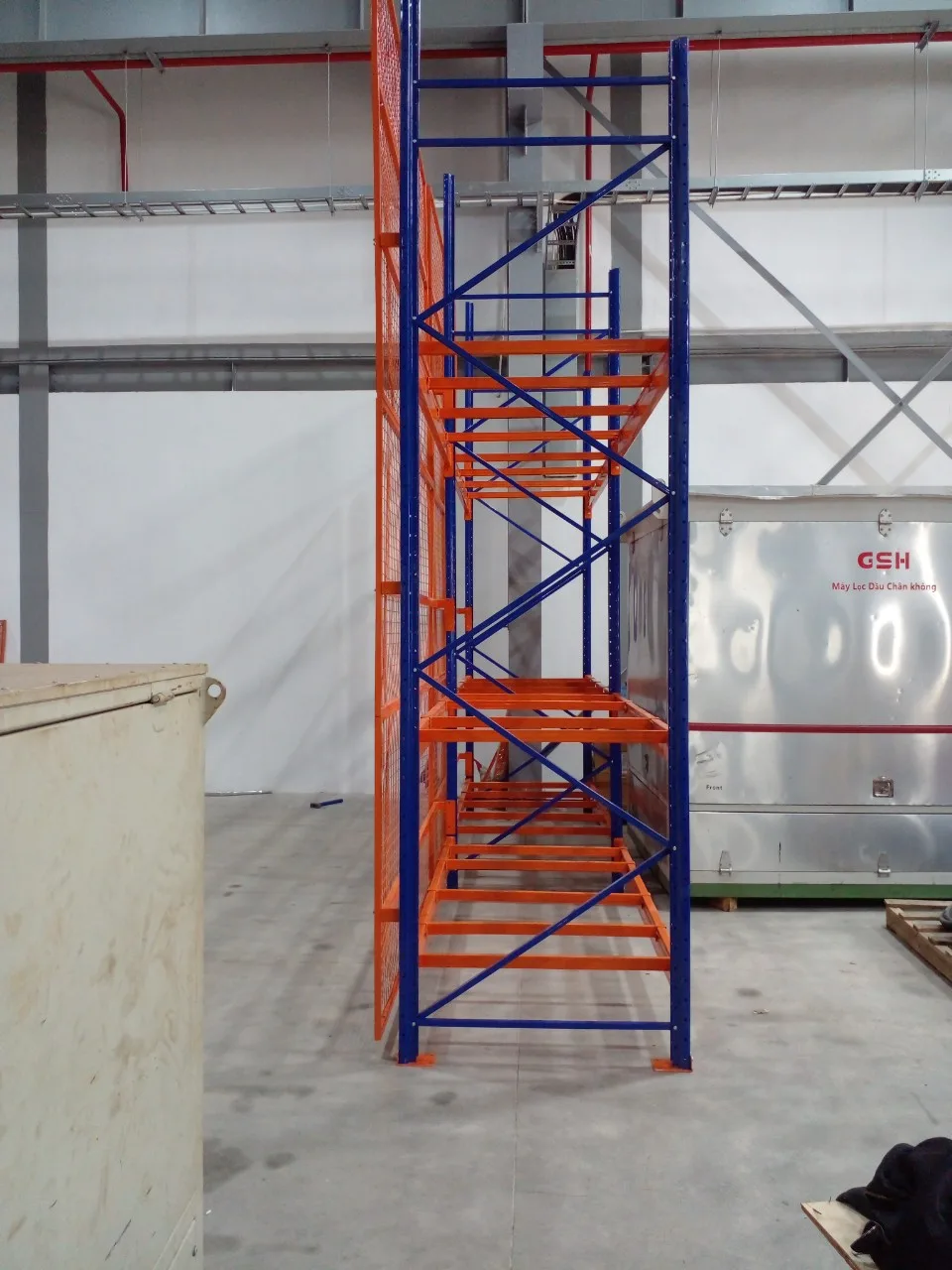
Rack safety mesh is a netting barrier fitted to pallet rack frames to stop goods, cartons or loose items falling out of their storage locations. The mesh is stretched between two uprights or fixed directly to the bracing, covering the full height of the bays that need protection. It is a rack safety accessory strongly recommended in the guidance of the UK Storage Equipment Manufacturers’ Association (SEMA), especially where racks border pedestrian walkways, in-warehouse offices, or back-to-back runs between two aisles.
A practical example: an electronic components warehouse stores small cartons (30×20 cm) on 8 m high selective racking, with the back of the racks facing a walkway used by workers. Without mesh, a carton pushed out of place during handling could fall freely from level 4–5 into the walkway. A 44 mm safety mesh fitted at the back of the racks catches the carton where it falls, keeping it out of the area where people walk.
Why do warehouses need safety mesh?
Safety mesh does not increase rack capacity or load rating, but it directly addresses one of the most common causes of warehouse accidents: objects falling from height. Here are 6 reasons industrial warehouses should fit anti-fall mesh to their racking.
- Stops goods falling onto pedestrians and forklifts. Areas next to walkways, offices and forklift charging stations are where SEMA (Storage Equipment Manufacturers’ Association, UK) guidance recommends mesh.
- Protects the opposite run on back-to-back racking. When two runs stand back to back, misplaced goods can fall into the bay on the other side; back mesh prevents this without widening the gap between runs.
- Reduces compensation and insurance costs. Many logistics insurers require fall-protection measures in high-risk areas before offering standard premiums.
- Suits loose goods not on standard pallets. Warehouses with many single cartons, soft packaging or loose parts see more shifting than with unitised pallets — fine mesh catches even small items.
- Keeps goods visible, unlike solid panels. Open mesh allows visual checks, counting and stocktaking without removing anything.
- Costs far less than solid steel panels or partition walls. Rope netting costs only about 20–30% of solid sheet/steel panels over the same area.
Safety mesh specifications
The mesh selection rule from Cisco-Eagle’s technical guide on specifying pallet rack safety netting: the mesh opening must be smaller than the smallest dimension of the smallest package or carton stored on the rack, so items cannot slip through when pushed.
| Mesh type | Material | Common mesh size | Installation position | Suitable goods |
|---|---|---|---|---|
| Rope netting | UV-coated nylon/polypropylene | 44 mm or 100 mm (1.75″ / 4″) | Rack backs, rack sides facing walkways | Cartons, soft packaging, medium-sized packages |
| Welded wire mesh | Galvanized welded steel wire, Ø3–4 mm | 50×50 mm or 100×50 mm | High-load positions, warehouses with forklifts working close to racks | Heavy goods, sharp-edged items, metal parts |
| Fine mesh | Dense woven nylon | 20–30 mm | Racks holding loose or small parts | Screws, electronic components, loose spare parts |
| Shelf-level netting | Nylon or light-gauge steel | 44–100 mm | Between rack levels, horizontal | Warehouses with many low levels where goods slide sideways |
| Mezzanine edge mesh | Heavier-duty welded steel | 50×50 mm, combined with guardrails | Mezzanine floor edges where people work | Warehouses with manual picking on mezzanine floors |
On load capacity: manufacturers state that standard rope netting is suitable for catching loose packages of moderate weight (common international reference values range from a few kg to a few tens of kg per item) — this is a reference estimate and does not replace each mesh manufacturer’s specific technical data. For heavier goods or sharp-edged items that could cut the netting, switch to welded wire mesh or rigid panels.

Safety mesh vs other fall-protection options
| Solution | Relative cost | Visibility of goods | Installation time | Main drawback |
|---|---|---|---|---|
| Safety mesh (rope/steel) | Low – Medium | Good (open mesh) | Fast, no welding | Needs replacing when rope wears after several years |
| Solid sheet/steel panels | High | Poor (fully blocked) | Longer, requires fabrication | Blocks airflow and light; hard to check stock visually |
| Horizontal guard rails (low-level crash barriers) | Low | Good | Fast | Only stops forklift impacts at rack base; does not stop goods falling from height |
| Nothing fitted (accepting the risk) | 0 VND | Good | — | Risk of workplace accidents; may breach insurer requirements or customer warehouse audits |
Rack safety mesh prices and cost drivers
Anti-fall mesh for warehouse racking in Vietnam typically costs 150,000–450,000 VND/m² including basic installation (market reference prices that vary over time and by supplier). The factors that directly affect cost are:
- Material: nylon rope netting is 40–60% cheaper than welded wire mesh for the same area.
- Rack height to be covered: racks over 8 m need intermediate tensioning frames, increasing work-at-height labour costs.
- Number of bays: the price per m² falls for large batches (a whole warehouse) compared with fitting a few bays.
- Tensioning accessories (hooks, wire ropes, aluminium edge frames): 10–20% of the total cost, affecting durability and mesh tension.
- UV/moisture resistance: mesh installed outside a roof or in high-humidity warehouses needs a UV-resistant coating, adding roughly 15–25% to material costs.
Long Quyen’s 5-step safety mesh installation process
Long Quyen applies the same survey – design – fabrication – installation – handover process to every racking accessory, including safety mesh, just as we do when dealing with damaged warehouse racking:
- Site survey: measure the height and length of each bay, identify priority positions (walkways, offices, back-to-back runs) and record the smallest package size to choose the right mesh opening.
- Design: choose the mesh type (rope/welded), mesh size, how the mesh is divided by rack level, and the positions of tensioning hooks and edge frames.
- Fabrication: cut the mesh to each bay’s dimensions, fabricate edge frames and prepare hooks and tensioning wire ropes.
- On-site installation: stretch the mesh from upright to upright and secure it with hooks or steel wire, keeping sag within limits so the mesh can absorb impact when goods hit it.
- Handover: check tension, ensure there are no gaps between adjacent mesh sections and no loose hooks, verify against the surveyed positions and hand over the acceptance record.
Example: safety mesh in an electronics distribution warehouse
A typical situation Long Quyen often meets when advising on safety accessories: an electronic components distribution warehouse in an industrial park in northern Vietnam, with 7–8 m selective racking where the backs of two facing rack runs border an inspection corridor used by workers throughout each shift. The goods are small component cartons (under 30 cm per side) that easily shift when picked from high levels with a reach truck.
Solution: 44 mm rope netting covering the full height of the backs of both runs, divided into sections every two rack levels so that individual levels can be accessed for maintenance. After installation, subsequent internal periodic inspections recorded no cartons falling outside the rack footprint into the inspection corridor. This is a common application model for electronics, pharmaceutical and FMCG warehouses with working aisles next to high-bay racks — not data from a specific named customer.
Common mistakes when installing rack safety mesh
Choosing a mesh opening larger than the smallest goods
The most common mistake: using 100 mm mesh throughout the warehouse even though some areas hold parts smaller than 10 cm — small items still slip through. Survey each storage area separately before choosing the mesh size.
Mesh too slack or too tight
Slack mesh sags heavily, so falling goods can still escape at the edges; over-tight mesh tears more easily under sudden impact instead of absorbing the force gradually.
Ignoring back-to-back rack positions
Many warehouses fit mesh only on the outer faces against walls and ignore the backs between two facing runs — yet this is a high-risk position, because goods can fall into the bays of the opposite run.
Not inspecting mesh condition regularly
Nylon mesh outdoors or in humid areas becomes brittle and degrades over time. Add safety mesh checks to your periodic rack inspection schedule (see also our article on warehouse rack inspection and acceptance), not just a one-off check at installation.
Leaving gaps between mesh sections
Joining adjacent mesh panels without connecting frames or overlapping ties leaves a gap exactly the width of a small package — defeating the fall protection right at the joint.
Rack safety mesh FAQ
Is rack safety mesh mandatory?
No Vietnamese regulation requires safety mesh in every position, but UK SEMA guidance recommends it where racks border pedestrian walkways, offices or back-to-back runs — and many FDI companies and large retail chains also require it when auditing their suppliers’ warehouses.
Should I choose rope netting or welded wire mesh?
Rope netting suits light to medium goods, costs less and is easy to fit and remove. Welded wire mesh suits areas where forklifts work close to the racks, heavy goods, or sharp-edged items that could cut nylon rope over time.
What mesh size is right?
The mesh opening must be smaller than the smallest dimension of the smallest package on the rack. 44 mm mesh suits most warehouses storing standard cartons; warehouses with loose parts under 10 cm should use 20–30 mm mesh.
Where on the rack is safety mesh most important?
Top priority is rack faces bordering pedestrian walkways and worker areas, followed by the backs between two facing runs (back-to-back) and mezzanine floor edges where people work.
Does safety mesh affect rack load capacity?
No. Safety mesh is not a structural component and does not change the design load of beams or uprights. It only catches falling objects and is completely independent of the main load-bearing structure.
How often should safety mesh be replaced?
There is no fixed interval for every warehouse. Include checks for brittleness, degradation and tension in your periodic rack inspection cycle (typically every 6–12 months), and replace the mesh immediately if strands are broken or brittle or openings have stretched abnormally.
Can we install safety mesh ourselves without a specialist?
Possible for small warehouses with low racks, but for racks over 6 m it is best to use an experienced contractor for the survey and work at height, to ensure even tension, correct priority positions and worker safety during installation.
Get a rack safety mesh quote within 2 working hours
Every warehouse has its own conditions: floor area, ceiling height, pallet loads and throughput. Long Quyen’s engineering team will survey your site and propose the best solution for your actual warehouse — free of charge. Fill in the form below, or call/Zalo +84 903 422 179, to receive a safety mesh quote within 2 working hours.
Long Quyen Manufacturing & Trading Co., Ltd. — industrial racking manufacturer since 1997 (nearly 30 years), 500+ projects, ISO 9001:2015.
Office: 79 Dao Tan, Giang Vo, Hanoi · Factory: 1085 Phuc Dien, Xuan Phuong, Hanoi
Phone/Zalo: +84 903 422 179 · Email: contact@giakelongquyen.com


