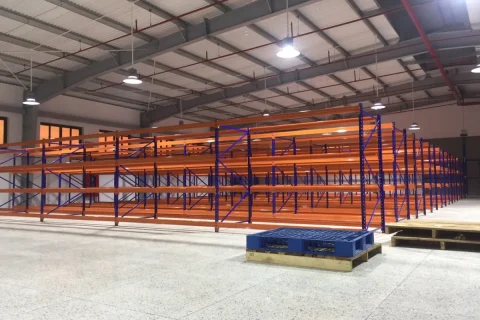
ABC analysis for warehouse racking layout is a method of dividing goods into three groups — A, B and C — by picking frequency, then placing group A (the fastest movers, typically 15–20% of SKUs but 70–80% of picks) in the rack positions closest to the dispatch door and easiest to reach. Applied correctly, it can cut picking travel distance by around 20–40% without buying more racking or expanding the warehouse.
At a glance:
- Group A = 15–20% of SKUs but 70–80% of picks (Pareto 80/20 rule) — place on low rack levels, near the dispatch door and main aisles.
- Group B = 20–30% of SKUs, 15–20% of picks — place in the middle zone of the warehouse.
- Group C = 50–65% of SKUs, only 5–10% of picks — place far from the dispatch door; can go on upper levels (high-rise selective racking) as they are rarely picked.
- No need to change racking type to apply ABC — simply re-slot goods on your existing racking, at almost zero cost if done in-house, or with a consulting survey for large warehouses.
- Re-run the ABC analysis every 6–12 months, as your fast-mover mix changes with seasons and new orders.
Table of Contents
- What is ABC analysis in warehouse racking layout?
- Why does an ABC racking layout boost picking productivity?
- How to classify goods into A-B-C: 4 calculation steps
- Racking layout principles for each A-B-C group
- ABC layout vs SKU-sequence/random layout
- Costs and factors when re-slotting a warehouse by ABC
- Long Quyen’s 5-step warehouse re-layout consulting process
- Illustrative example: a 1,200-pallet-position warehouse
- 5 common mistakes when applying ABC
- Frequently asked questions
What is ABC analysis in warehouse racking layout?
ABC analysis (also called slotting when applied to rack positions) is an inventory management technique based on the Pareto principle: a small share of SKUs generates most of the inbound and outbound activity. In general inventory management, ABC is usually used to classify stock by value; but when applied to racking layout, the right criterion is picking frequency, not monetary value — a low-value SKU that ships constantly still belongs in a group A location.
Wikipedia defines ABC analysis as a method of classifying inventory into three groups by importance, with group A accounting for the largest share of value or activity despite having the fewest SKUs — a principle that applies directly to industrial warehouse racking layout.
Why does an ABC racking layout boost picking productivity?
In a warehouse operated manually or semi-automatically (forklifts, reach trucks), most of a warehouse operator’s time is spent not “picking” but travelling to the pick location. According to logistics industry references (compiled sources; figures are estimates, as no dedicated survey exists for the Vietnamese market), travel can account for 50–60% of the total picking cycle time in a randomly slotted warehouse. When fast movers (group A) are scattered or far away, every order adds unnecessary travel distance.
Re-slotting by ABC requires no extra racking and no extra floor space — only rearranging goods on your existing racking. That is why it is the lowest-cost, fastest-payback warehouse optimisation measure, and Long Quyen typically provides it as free advice alongside new racking installation projects or surveys for upgrading existing warehouses.

How to classify goods into A-B-C: 4 calculation steps
- Step 1 — Get picking data: export a report of the number of outbound picks (not quantities, but the number of TIMES each item is picked) per SKU for the last 3–6 months from your WMS/ERP or outbound log.
- Step 2 — Sort in descending order: rank all SKUs by number of picks from highest to lowest and calculate the cumulative % of picks.
- Step 3 — Cut groups by cumulative threshold: group A = SKUs up to ~70–80% of total picks cumulatively; group B = the next SKUs up to ~90–95%; group C = the rest.
- Step 4 — Check physical characteristics: exclude or adjust SKUs with special characteristics (heavy goods needing a dedicated forklift, fragile goods, batch-controlled goods requiring strict FIFO) before assigning locations — do not apply ABC mechanically, 100% by the numbers.
| Group | Share of SKUs (estimate) | Share of picks (estimate) | Characteristics |
|---|---|---|---|
| A | 15–20% | 70–80% | Fast movers, shipped continuously every day |
| B | 20–30% | 15–20% | Shipped regularly but not intensively |
| C | 50–65% | 5–10% | Slow movers, long-dwell stock, seasonal goods |
The figures in the table are common reference ratios based on the Pareto 80/20 principle used in inventory management — each warehouse’s actual ratios must be calculated from the company’s own inbound/outbound data and should not be applied rigidly to every industry.
Racking layout principles for each A-B-C group
Once the groups are defined, apply the following principles on the selective, drive-in or double-deep racking already in your warehouse:
| Group | Preferred location | Rack level | Reason |
|---|---|---|---|
| A | Near the dispatch door, at aisle ends, along main aisles | Low levels (levels 1–2, at forklift/operator working height) | Minimises travel distance and lifting/lowering time per pick |
| B | Middle zone of the warehouse | Middle levels | Balances accessibility and space utilisation |
| C | Far from the dispatch door, at the end of rows, warehouse corners | Top levels (applicable to high-rise racking) | Rarely picked, so slower handling is acceptable in exchange for saving floor space |
For warehouses with several racking types, an additional principle applies: group A should sit on pallet flow racking (FIFO gravity flow) or direct-access selective racking for fast handling; group C suits drive-in or high-rise selective racking, accepting slower access in exchange for higher storage density.

ABC layout vs SKU-sequence/random layout
| Criterion | ABC layout (by frequency) | SKU-sequence/random layout |
|---|---|---|
| Picking travel distance | Shorter for most orders (group A accounts for most picks) | Not optimised; depends on random positions |
| Implementation cost | Almost zero if re-slotted in-house; a fee if a survey is outsourced | No upfront cost, but higher long-term operating cost |
| Data required | 3–6 months of inbound/outbound history | None |
| Periodic maintenance | Yes — re-analyse every 6–12 months | No |
| Suitable scale | Warehouses with a few hundred pallet positions or more and many SKUs | Very small warehouses with few SKUs, where locations are easy to remember |
Costs and factors when re-slotting a warehouse by ABC
ABC analysis itself involves no equipment purchase — this is what sets it apart from other warehouse optimisation measures (such as upgrading racking or adding a mezzanine floor). Actual costs arise from:
- Labour to move goods to their new locations — off-peak hours can be used to avoid disrupting operations.
- Location tracking software/tools — if the warehouse has no WMS, at minimum an Excel sheet or a manually updated location map is needed to avoid mix-ups after re-slotting.
- Survey and consulting fees — if an outside firm surveys the site and prepares the re-layout plan, the cost depends on warehouse size; Long Quyen surveys and advises on layout free of charge as part of a racking installation or upgrade project.
- Safety accessory adjustments — if you change racking types by group (e.g. moving group A to pallet flow), new racking investment is required and should be factored into the long-term ROI calculation.
Long Quyen’s 5-step ABC warehouse re-layout consulting process
- Site survey: measure the floor plan, photograph existing racking and record forklift/operator traffic flows.
- Collect inbound/outbound data: work with the client’s warehouse team to obtain picking reports for the last 3–6 months.
- Analyse and draft the A-B-C plan: calculate the groups and propose a new location map on the existing racking (or recommend additional racking if needed).
- Implement the re-layout: guide the warehouse team in moving goods according to the new map, with clear location labels and signage.
- Monitor and fine-tune: review after 1–3 months of operation and adjust groups if the inbound/outbound mix changes.
Illustrative example: a 1,200-pallet-position warehouse
Consider an industrial warehouse with 1,200 pallet positions on selective racking and around 400 different SKUs. Applying the Pareto principle correctly, group A (roughly the 60–80 fastest-moving SKUs) should be placed in the 2–3 rack rows closest to the dispatch door, on levels 1–2. This is a generalised example to explain the principle, not measured data from a specific project — the actual reduction in travel distance depends on each warehouse’s floor plan, daily order volume and SKU mix, and an on-site survey is needed for accurate figures.

5 common mistakes when applying ABC
1. Using inventory value instead of picking frequency
A high-value SKU that rarely ships should not occupy a group A location — positions near the dispatch door should be reserved for items with high picking frequency, not high monetary value.
2. Not updating for seasonality
Summer fast movers differ from winter ones (especially in FMCG and building materials). Keeping the same ABC layout all year causes its benefits to fade after a few months.
3. Ignoring the physical characteristics of goods
Heavy or bulky goods classified as group A by picking data but placed on high levels make handling difficult and create safety risks — combine frequency with weight and dimensions when deciding locations.
4. Not relabelling or updating the system after re-slotting
Moving goods physically but forgetting to update the warehouse map or management software leads operators to search in the wrong place, taking longer than before optimisation.
5. Applying ABC while neglecting aisle safety
Concentrating group A goods in one area can congest forklift aisles at peak times unless traffic flows are recalculated — combine ABC with regular racking inspection and maintenance to stay safe as handling frequency in the group A zone increases.

Frequently asked questions
How does warehouse ABC analysis differ from ABC analysis in inventory accounting?
Inventory accounting uses ABC by monetary value to prioritise control and stock counts. Warehouse racking layout uses ABC by picking frequency to optimise travel distance — two different classification criteria, even though both are called “ABC”.
Does a small warehouse with fewer than 200 pallet positions need ABC?
In very small warehouses the benefit is usually modest, as travel distances are already short. ABC delivers the clearest results in warehouses with a few hundred pallet positions or more and dozens to hundreds of SKUs.
How often should ABC analysis be repeated?
Every 6–12 months is recommended, or immediately when your product or customer mix changes significantly (new product launches, peak season, a major new customer).
Do I need WMS software to apply ABC?
No. Warehouses without a WMS can still apply ABC using data from outbound delivery notes or a manually maintained Excel file, as long as there are 3–6 months of picking history per SKU.
Do I need to change my current racking type to apply ABC?
No. ABC is about arranging locations on your existing racking. Changing racking types (e.g. adding pallet flow for group A) is only an optional upgrade once basic slotting has been optimised.
Can ABC be applied to drive-in racking?
Yes, but note that drive-in racking operates LIFO (last in, first out) within each lane — making it better suited to group B/C goods that need less frequent access than to group A goods that are picked continuously.
Get free ABC warehouse racking layout advice
Every warehouse has its own product mix and inbound/outbound flows — there is no standard ABC layout that fits every business. Long Quyen’s engineering team surveys your current setup and advises on a racking re-layout based on your warehouse’s actual data — free of charge as part of a racking installation or upgrade project. Fill in the form below, or call/Zalo us on +84 903 422 179.
Long Quyen Manufacturing & Trading Co., Ltd. — manufacturing industrial racking since 1997 (nearly 30 years), 500+ projects, ISO 9001:2015 certified.
Office: 79 Dao Tan, Giang Vo, Hanoi · Factory: 1085 Phuc Dien, Xuan Phuong, Hanoi
Hotline: +84 903 422 179 (Zalo – Dat) · +84 903 412 296 (Hien) · +84 903 434 374 (Cam) · Email: contact@giakelongquyen.com
References: Wikipedia — ABC analysis · MHI — CICMHE Resources (warehouse design and optimisation)