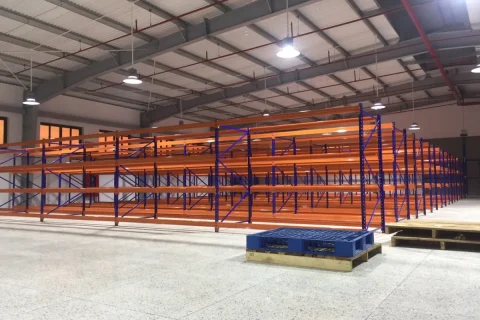
Longspan shelving (also called long span or wide span shelving) is a non-pallet warehouse shelving system whose horizontal beams run 1.8–3 m per bay and carry decks of plywood, particleboard or wire mesh. Each level typically holds 100–500 kg (depending on bay length and number of levels), making longspan shelving ideal for loose items, cartons, files, small mechanical components and automotive spare parts — exactly where pallet-based selective racking or standard medium-duty shelving would be too bulky and waste space.
Quick summary: longspan shelving is long-span, pallet-free shelving with 100–500 kg per level and an indicative cost of about VND 450,000–950,000 per m² of shelf (2026, reference only — see Section 6 for cost drivers). It suits spare-parts stores, archives, component stores and carton picking. Compared with medium-duty shelving, longspan has longer bays (1.8–3 m vs 0.9–1.5 m), fewer uprights over the same length, and decks (board or wire mesh) that carry the load directly instead of wooden pallets.
Contents
- What is longspan shelving?
- Components in detail
- Reference load & dimension table
- Longspan vs medium-duty shelving vs slotted angle shelving
- When to use longspan shelving — and when not to
- Longspan shelving prices in 2026 & cost drivers
- Long Quyen’s 5-step installation process
- Common mistakes when selecting/installing longspan shelving
- Frequently asked questions (FAQ)
1. What is longspan shelving?
Longspan shelving (also known as long span shelving or wide span racking) is a type of industrial shelving whose defining feature is the beam span: typically 1.8–3 m per bay, considerably longer than standard medium-duty shelving (0.9–1.5 m per bay) or multi-purpose slotted angle shelving (0.6–1.2 m per bay).
Because the spans are long, longspan shelving needs fewer upright frames over the same run length. This reduces the number of load points but also reduces the maximum load per level compared with shorter-span shelving made from the same steel section. It is important to understand this when comparing systems: longspan is not “weaker” — it is a trade-off between span length, load capacity and number of uprights.
Longspan shelving is not designed to hold pallets directly on the beams like selective racking. Every storage level must have a deck (plywood, particleboard, perforated steel panel or welded wire mesh) to spread the load evenly onto the beams, because the gap between the two beams is too wide for loose boxes or items to sit on directly.
2. Components in detail
- Upright frames: box-section or C-section steel, punched at a fixed pitch (usually 50 mm) so level heights can be adjusted freely. Common heights are 2–6 m, and taller when combined with a mezzanine.
- Beams: rectangular hollow section or cold-rolled C-section steel, 1.8–3 m per bay — the component that gives “longspan” its name. Beams connect to the uprights with safety hooks/locks (boltless) or bolted brackets, depending on the product line.
- Decks: three common options — (1) moisture-resistant film-faced plywood or particleboard: the cheapest, suited to dry goods; (2) welded wire mesh decks: ventilated, better for fire safety, easy to clean, popular in component and spare-parts stores; (3) steel or perforated steel panels: the highest load capacity of the three, used for heavy goods or warehouses with strict fire-safety requirements.
- Horizontal & diagonal bracing: increases stability in the depth direction and prevents overturning; mandatory for shelving taller than 3–4 levels or in areas with dynamic loads (forklifts, people moving close to the shelving).
- Base plates: distribute upright loads into the concrete floor, with anchor bolts specified to suit each site’s structural conditions.
- Optional accessories: level/location labels for 5S-style location coding, side anti-fall mesh where shelving faces a shared aisle, and bottom corner guards to protect uprights from trolley or hand pallet truck impacts.
3. Reference load & dimension table
The figures below are common reference ranges in the material handling industry, compiled from general design practice — not survey data from a specific Long Quyen project. Actual load capacities for each project must be calculated individually based on the structural design and applicable Vietnamese standards (TCVN).
| Parameter | Reference range |
|---|---|
| Beam span | 1,800 – 3,000 mm per bay |
| Load per level (uniformly distributed on board/mesh deck) | 100 – 500 kg per level; some heavy-duty lines reach 800 kg per level |
| Shelf depth | 400 – 1,200 mm, most commonly 600 mm and 900 mm |
| Upright height | 2,000 – 6,000 mm, level adjustment pitch 50 mm |
| Typical number of levels | 4 – 8 levels (loose-item stores); more when combined with a mezzanine |
| Deck type | Film-faced plywood / welded wire mesh / perforated steel panel |
| Accessibility | 100% — picked directly by hand or trolley; no forklift needed for lower levels |
4. Longspan vs medium-duty shelving vs slotted angle shelving
These three shelving types are often confused because all of them handle loose items without pallets. The table below compares them on the same criteria so you can choose the right type for each storage need.
| Criterion | Longspan shelving | Medium-duty shelving | Slotted angle shelving (light boltless) |
|---|---|---|---|
| Beam span | 1.8 – 3 m | 0.9 – 1.5 m | 0.6 – 1.2 m |
| Load per level | 100 – 500 kg (some lines up to 800 kg) | 150 – 800 kg | 50 – 150 kg |
| Upright frames per 10 m single run | Fewest (approx. 5–7) | Medium (approx. 8–13) | Most (approx. 10–18) |
| Suitable goods | Medium-to-large loose items, spare parts, high-volume files | Cartons, components, assembly parts | Light goods, offices, small stores, DIY assembly |
| Installation speed over the same area | Faster (fewer uprights and joints) | Medium | Slower over large areas (many uprights) |
| Cost per m² of shelf (2026 reference) | Medium-to-low thanks to fewer uprights | Medium | Lowest per unit, but more units needed |
Bottom line: if you store bulky, irregularly sized goods and need open aisles with fewer uprights in the way of trolleys and people, longspan wins. If your goods are uniform cartons or standard bins and you need higher capacity on a small footprint, medium-duty shelving is the better fit. For small stores on a tight budget that need quick self-assembly, slotted angle shelving is the most economical choice.
5. When to use longspan shelving — and when not to
Use it for: automotive and motorcycle spare-parts stores (long, bulky, irregularly sized parts); large-volume file and document archives for offices, banks and public agencies; mechanical component stores; textile and garment accessory stores (fabric rolls, thread cones); showrooms or retail stockrooms that combine display and storage; and warehouses with low ceilings or tight floor space that still need to maximise loose-item storage.
Do NOT use it when: goods are already palletised uniformly and handled directly by forklifts (choose selective or drive-in racking); unit loads continuously exceed 500–800 kg per level (you need dedicated medium- or heavy-duty shelving); you need maximum storage density in depth (longspan does not optimise depth density the way drive-in or pallet flow racking does); or the budget is very limited and volumes are small — slotted angle shelving will be more economical.
When planning the layout, keep main aisles wide enough for hand trolleys or hand pallet trucks to pass in both directions (typically 1.2–1.5 m depending on the equipment), and make the secondary aisles between rows wide enough for pickers to work comfortably without hitting goods in the opposite row. Poor aisle planning is a common reason a longspan store feels more “cramped” than designed, even though shelving density has not changed.
6. Longspan shelving prices in 2026 & cost drivers
The prices mentioned in this article are general reference ranges for Vietnam’s industrial warehouse shelving market in 2026, NOT Long Quyen’s fixed official price list. Actual prices depend on design load, steel thickness, deck type, quantity, and transport/installation costs for each site. Long Quyen provides an exact quotation after a site survey or after receiving your details via the quotation form.
- Plywood decks: the lowest cost of the three deck types; suited to dry goods without special fire-safety requirements.
- Wire mesh decks: more expensive than plywood but ventilated, easy to clean and better for fire safety — suitable for component stores and warehouses with strict fire-safety requirements.
- Steel thickness of uprights/beams: directly affects maximum load and price — thicker steel gives higher capacity, but cost rises with steel weight.
- Shelving height and number of levels: shelving taller than 4 m usually needs extra bracing and stronger floor anchoring, which affects installation cost.
- Order quantity: large orders (many bays with the same specification) usually get a better unit price thanks to optimised steel cutting and transport.
- Transport & installation: depends on the distance from the Long Quyen factory (1085 Phuc Dien, Xuan Phuong, Hanoi) to your site — customers in Hanoi and northern Vietnam can usually minimise this cost the most.
7. Long Quyen’s 5-step longspan shelving installation process
- Site survey & measurement: Long Quyen engineers survey the floor area, goods types, inbound/outbound frequency and expected load per level.
- Design & structural calculation: define beam span, number of levels, deck type and aisle widths in line with Vietnam’s fire-prevention regulations and applicable TCVN standards.
- Quotation & material confirmation: detailed quotation based on the designed configuration; confirmation of steel, powder coating/galvanising and production lead time at the Xuan Phuong factory.
- Manufacturing & delivery: uprights, beams and decks are fabricated to the design specification, packed and delivered to site.
- Installation, acceptance & handover: installation according to drawings, checks of plumbness and load-bearing, signing of the acceptance record, and user/maintenance guidance for your team.
8. Common mistakes when selecting/installing longspan shelving
- Placing heavy or bulky goods beyond the design load on thin plywood decks — the deck sags and a level may collapse even though the uprights and beams still have capacity.
- Omitting diagonal bracing on shelving taller than 4 levels — the shelving sways under dynamic loads (people or trolleys bumping into it), increasing the risk of overturning over time.
- Using very long spans (3 m) for heavy, unevenly distributed loads — beams deflect at mid-bay even when the total load is within the average rating.
- Skipping proper base plates and floor anchors when installing on low-strength concrete slabs or on upper floors.
- Confusing longspan with medium-duty shelving when requesting quotes — they look similar, which leads to the wrong load configuration for the actual goods.
9. Frequently asked questions (FAQ)
1. Can longspan shelving be used for pallets?
Placing pallets directly on longspan beams is not recommended because the span is too long relative to standard pallet sizes. If you need to store both pallets and loose items, separate the areas using selective racking or medium-duty shelving.
2. What is the maximum load of longspan shelving?
Typically 100–500 kg per level with standard steel, and some heavy-duty lines reach 800 kg per level. The exact capacity depends on steel thickness, beam span and deck type, and should be calculated by Long Quyen for your specific requirements.
3. Should I choose plywood or wire mesh decks?
Plywood is cheaper and suits dry goods without special fire-safety requirements. Wire mesh costs more but is ventilated, easy to clean and better meets strict fire-safety requirements — choose according to the fire-prevention rules applicable to your facility.
4. How is longspan shelving different from office file shelving?
Office file shelving is usually a lighter-duty version of the same long-span principle, more compact for office spaces. Industrial longspan shelving has higher capacity and larger dimensions, using thicker steel for production and logistics warehouses.
5. Can longspan shelving be combined with a mezzanine?
Yes — this is a common way to use warehouse height, adding 1–2 storage or working levels above the longspan shelving below. The mezzanine floor requires its own structural calculation.
6. How long does a typical longspan installation take?
It depends on scale — a small store of a few dozen m² can be installed in 1–2 days, while large warehouses of hundreds to thousands of m² take from several days to a few weeks depending on manpower and component production schedules.
7. Does Long Quyen provide a warranty for longspan shelving?
Yes — the specific warranty period is stated in each project’s contract/quotation. Please confirm directly with Long Quyen via the hotline or quotation form for accurate information on your configuration.
10. Get a longspan shelving quotation from Long Quyen
Operating since 1997 – nearly 30 years, with 500+ projects, ISO 9001:2015 quality management and its own factory at 1085 Phuc Dien, Xuan Phuong (Hanoi), Long Quyen designs and quotes longspan shelving for your actual loads, deck type and floor layout — never a one-size-fits-all configuration.
Request a free site survey & quotation:
Phone: +84 903 422 179 (Zalo)
Zalo: zalo.me/0903422179 · Email: contact@giakelongquyen.com
Contact page: giakelongquyen.com/en/contact/ · Quick quotation form: https://tally.so/r/nGkJVO
Related articles
- Selective vs Drive-in vs Double Deep Racking — Which to Choose?
- Light Slotted Angle Shelving — 50–150 kg per Level, Easy Self-Assembly
- Pallet Flow Racking — Automatic FIFO
- Warehouse Racking Damage: 3 Risk Levels & Standard Thresholds
- Cold Storage Racking — Rated to -30°C
Technical references: RMI Rack Safety — The Difference Between Racking and Shelving; ANSI MH28.2-2022 — Design and Testing of Industrial Steel Boltless Shelving.