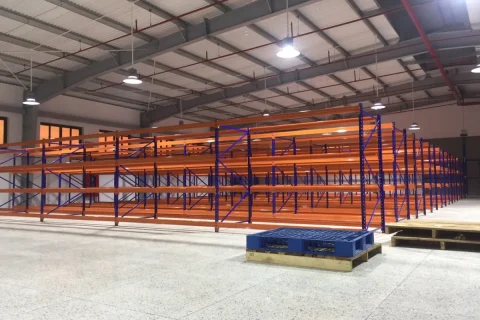
Pallet racking safety accessories – column guards, end-of-aisle barriers, anti-collapse mesh, beam locking pins and load signs – are small components, but they determine whether a warehouse runs safely. Most racking incidents are caused not by weak racks but by forklift impacts and incorrect loading. This article explains each accessory, where to use it, and how to choose the right set for your warehouse.

Why does pallet racking need safety accessories?
Think of a racking system as a car: the chassis (uprights and beams) determines load capacity, while seat belts, airbags and bumpers are the safety accessories. However good the car, it still needs bumpers, because accidents usually come from outside. In a warehouse, “outside” means forklifts: even a light knock on a lower upright can dent its section and reduce the capacity of the whole frame.
Safety accessories address three main risks:
- Impact: forklifts hitting upright bases and rack corners.
- Falling goods: cartons or pallets falling from upper levels into the aisle or the adjacent run.
- Overloading and incorrect handling: operators unaware of load limits, or beams being knocked out of the uprights when a forklift lowers a pallet.

1. Column guards (upright protectors)
Steel or plastic protectors wrapped around the base of the upright, typically 300–600 mm high, absorbing impacts from forklift tines and wheels. They are low-cost and highly effective.
Where to install: every upright facing a forklift aisle, especially at turning points and in loading/receiving areas. See models and specifications on our column guards page.

2. End-of-aisle barriers
U-shaped steel frames or guard rails placed at the end of each rack run to protect the end frame – the spot most often hit when forklifts turn into an aisle. Barriers also help separate pedestrian and forklift traffic.
Where to install: run ends facing main aisles and areas with heavy pedestrian traffic. See warehouse safety barriers.

3. Anti-collapse mesh
Steel mesh panels fitted to the back of a rack run (or between two back-to-back runs) to stop goods being pushed off the far side when a forklift places a pallet too deep.
Recommended when: racks stand next to pedestrian walkways or offices, or when storing loose cartons or fragile goods. Details on our anti-collapse mesh page.
4. Wire mesh decking and pallet support bars
Wire mesh decking and pallet support bars sit across a pair of beams to support non-standard pallets, pallets with damaged bottom boards, or cartons placed directly on the level. They stop goods from dropping between the two beams – one of the most common causes of falling loads.
See also wire mesh decking for racking.
5. Beam locking pins
Small safety locks fitted at the beam-to-upright connection to stop the beam lifting out when forklift tines accidentally catch its underside. They cost very little, yet are often missing or lost after a few level adjustments.
Rule: every beam end must have a locking pin; re-check whenever a level is moved.
6. Load notices and identification labels
Load notices state the maximum load per level and per bay and are displayed at the end of each run where operators can easily see them. The European standard EN 15635 on the application and maintenance of storage equipment requires load information to be clearly displayed to operators.
The load notice is the “contract” between the designer and the user: whenever the rack configuration changes (adding levels, changing level heights), the load ratings must be recalculated. Read more on rack load signs and warehouse racking safety rules, and how to calculate capacity in how to calculate pallet rack load capacity.
7. Row spacers, anchor bolts and base plates
Row spacers connect two back-to-back rack runs to improve stability. Anchor bolts fix the upright base plates to the floor. For high-bay racking, these are mandatory rather than optional.
Quick selection table by warehouse situation
| Situation | Priority accessories |
|---|---|
| Many forklifts, narrow aisles | Column guards, end-of-aisle barriers |
| Racks next to walkways / offices | Anti-collapse mesh, pedestrian segregation barriers |
| Mixed pallet sizes, loose cartons | Wire mesh decking, pallet support bars |
| Racks over 6 m high | Row spacers, anchor bolts, anti-collapse mesh |
| Multiple shifts, many new operators | Load notices, location labels, safety training |
Accessories only work when they are inspected regularly
Dented guards, missing beam pins, mesh removed to reach goods – all are very common after 6–12 months of operation. Combine accessories with regular rack inspections (using the Green – Amber – Red classification) and operator training. Long Quyen provides rack inspection and warehouse safety training services for businesses.
Frequently asked questions
Can safety accessories be added to existing racking?
Yes. Most column guards, barriers, anti-collapse mesh and mesh decks can be retrofitted to racking already in use. An engineer needs to measure the upright section, hole pitch and beam length to select compatible accessories.
What share of the racking system cost do safety accessories represent?
It depends on the level of protection, but it is usually a small fraction of the total racking value – while repairing a damaged rack frame, plus damaged goods and warehouse downtime, costs far more.
Does Long Quyen supply racking and accessories as a package?
Yes. Since 1997 – for nearly 30 years – Long Quyen has manufactured pallet racking and safety accessories and installed them nationwide across Vietnam as a complete package. Call +84 903 422 179 (Zalo) for a free site survey and quotation.