
Pallet shuttle racking (also called radio shuttle racking) is a high-density storage system that uses an electric shuttle car to automatically push and retrieve pallets inside deep rack lanes, so forklifts no longer have to drive into the rack as they do with traditional Drive-In racking. It is best suited to warehouses with few SKUs but many pallets per SKU — typically cold stores, FMCG raw-material warehouses and component warehouses for batch production.
Quick summary
- Pallet shuttle uses an electric shuttle car running in deep rack lanes and increases storage density by roughly 60–85% compared with Selective racking on the same floor area (industry reference figures, see section 3).
- There are 2 operating modes: semi-automatic (the shuttle travels inside the lane while a forklift places/collects the shuttle at the lane entrance) and fully automatic (combined with conveyors/AS-RS, no forklift needs to approach the rack).
- Suitable for warehouses with few SKUs, many pallets per SKU and batch-based stock rotation (FIFO/LIFO depending on configuration), especially cold stores and production raw-material warehouses.
- Investment is higher than Drive-In or Double Deep racking because of the added mechatronics (shuttle car, battery, controller) — ROI should be calculated on actual inbound/outbound frequency, not only on the floor space saved.
- Not the right fit if the warehouse has many SKUs with few pallets per SKU — in that case Selective or Double Deep racking is usually more cost-effective.
Contents
- What is pallet shuttle racking?
- Advantages and technical features
- Reference technical specifications
- Comparison with other high-density solutions
- Price and cost components
- 5-step implementation process
- Real-world applications
- Common mistakes
- Frequently asked questions (FAQ)
What is pallet shuttle racking?
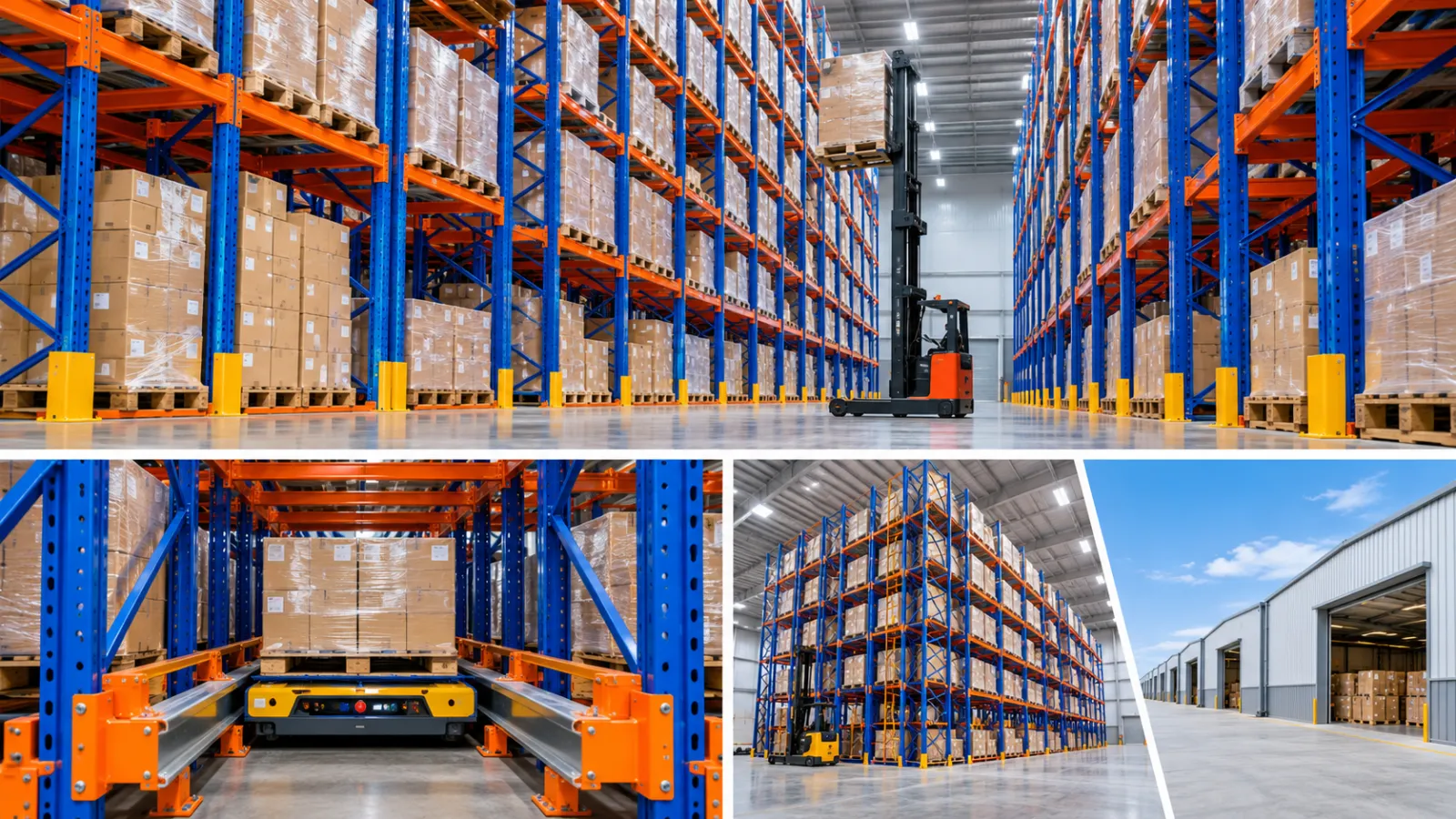
Pallet shuttle racking is a high-density system in which an electric shuttle car travels inside the rack lane to automatically push pallets deep into the lane or pull them out, instead of the forklift having to drive all the way into the rack as with Drive-In racking. The rack frame is still a steel structure with twin rails running along the lane, similar to Drive-In, but the forklift only needs to place the shuttle and the pallet at the lane entrance — the travel deep into the lane is handled by the shuttle.
A practical example: a blast-freezer cold store with lanes 10 pallets deep. With Drive-In racking, the forklift must drive in to the 8th–10th pallet position to pick goods — very slow and risky at sub-zero temperatures. With pallet shuttle, the forklift simply places the shuttle at the lane entrance; the shuttle runs in, picks exactly the pallet to be dispatched and brings it to the front for the forklift — handling time drops significantly and the forklift never has to go deep into the cold zone.

Advantages and technical features of pallet shuttle
1. Higher storage density on the same floor area
Because no forklift aisle is needed deep inside the lane, this solution allows deeper lanes (10–20+ pallets per lane depending on design) while keeping handling speed under control — according to industry technical documentation from Mecalux — an international manufacturer of Pallet Shuttle systems storage density can increase by roughly 60–85% compared with traditional Selective racking on the same warehouse floor area.
2. Less forklift travel inside the rack
The forklift works only at the lane entrance and does not drive deep inside as with Drive-In — reducing tyre wear and the risk of hitting the rack frame, which is especially valuable in cold stores because the forklift does not stay long in the sub-zero area.

3. Flexible FIFO or LIFO depending on lane configuration
If lanes are accessible from both ends (through-flow), the system can operate FIFO (in at one end, out at the other) — suitable for goods with expiry dates such as food and pharmaceuticals. If there is only one entry/exit, the system operates LIFO like a conventional Drive-In rack.
4. Battery-powered shuttle with remote control
Shuttle cars usually run on Lithium-ion batteries, charged off-board or directly at the lane entrance, and are controlled by remote or by a wirelessly connected warehouse management system (WMS) — operators never need to enter the rack lane to intervene.

5. Less damage to pallets and goods
Because pushing/pulling pallets is controlled by mechatronics with precise speed and positioning (unlike a forklift manoeuvring manually many times in a narrow lane), pallet shuttle systems usually reduce collisions that dent pallets or topple goods compared with Drive-In racking operated entirely by forklift.
6. Easy upgrade to full automation (AS/RS)
Semi-automatic pallet shuttle is a sensible stepping stone before investing in a fully automated warehouse (AS/RS combining conveyors + robots). The twin-rail rack structure is compatible with later adding a stacker crane or a central control system if automation needs grow.
Reference technical specifications for pallet shuttle
The table below summarizes common reference specifications of pallet shuttle systems on the market (based on industry technical documentation and international shuttle manufacturers) — these are reference ranges for initial design guidance; actual specifications will be calculated by Long Quyen’s engineering team according to your load, pallet dimensions and specific warehouse conditions.
| Parameter | Reference range | Notes |
|---|---|---|
| Load per pallet (shuttle car) | 500 – 1.500 kg | Depending on shuttle model, most commonly 1,000–1,200 kg |
| Load per rack level (frame structure) | 1,000 – 3,000 kg/position | Calculated from beam & rail design, checked against the pallet racking structural standard of Rack Manufacturers Institute (RMI) |
| Lane depth | 10 – 20+ pallets/lane | Deeper than conventional Drive-In (usually limited to 4–8 pallets/lane because forklifts struggle to go deep) |
| Compatible pallet sizes | 800×1.200 mm / 1.000×1.200 mm / 1.100×1.100 mm | Must match the installed rail dimensions exactly |
| Shuttle travel speed | ~0.5 – 1.5 m/s (unloaded) | Slower when loaded, depending on safety mode |
| Power supply | Lithium-ion battery, charged off-board or in the lane | Charging time and capacity depend on the shuttle manufacturer |
| Operating temperature | From -30°C to +40°C (depending on shuttle model) | A cold-resistant shuttle model must be selected for freezer warehouses |
| Maximum rack height | Equivalent to Drive-In racking of the same material, typically 8–12 m | Practical limit set by warehouse ceiling height and floor load capacity |
Pallet shuttle racking compared with other high-density solutions
This is the real buying decision: should your warehouse choose Selective, Double Deep, Drive-In or Pallet Shuttle? The table below puts the 4 solutions side by side on the key criteria.
| Criteria | Selective | Double Deep | Drive-In | Pallet Shuttle |
|---|---|---|---|---|
| Storage density | Lowest (100% direct access) | Medium (~2x Selective) | High (lanes 4–8 pallets deep) | Highest (lanes 10–20+ pallets deep) |
| Suitable number of SKUs | Many SKUs, few pallets per SKU | Medium number of SKUs | Few SKUs, many pallets per SKU | Very few SKUs, very many pallets per SKU |
| Throughput speed | Fastest (direct access to every pallet) | Medium | Slow (forklift must drive deep) | Faster than Drive-In (the shuttle fetches goods by itself) |
| FIFO/LIFO | Free FIFO | Mainly LIFO | LIFO | FIFO or LIFO depending on lane design |
| Initial investment | Lowest | Medium | Medium-high | Highest (added mechatronics) |
| Cold storage suitability | Possible, but wastes refrigerated space | Good | Good, but the forklift must enter deep into the cold zone | Best — the forklift does not have to enter deep into the cold zone |

Quick selection rule: if the warehouse has more than 30–40 different SKUs and each SKU has only a few pallets, Selective or Double Deep remain more cost-effective. If the warehouse has fewer than 10–15 SKUs but each SKU holds dozens to hundreds of pallets — typically cold stores and batch-production raw-material warehouses — Drive-In or Pallet Shuttle really pays off, and Pallet Shuttle is worth extra consideration when throughput is high or the warehouse operates at sub-zero temperatures.
Pallet shuttle racking price and cost components
A pallet shuttle system has 2 separate cost components: (1) the twin-rail steel rack frame — priced per m² or per pallet position, equal to or slightly above a Drive-In frame of the same load; (2) the shuttle cars — priced per unit; this is the part that determines the total investment, because one shuttle can serve several lanes if laid out properly (not necessarily one shuttle per lane).
- Number of shuttle cars to purchase — the biggest factor in total cost; it must be calculated from actual inbound/outbound frequency, not from the number of lanes.
- Pallet load and dimensions — heavy, oversized pallets need a higher-capacity shuttle model, and equipment price rises accordingly.
- Cold-resistance requirement — shuttles for freezer warehouses at -18°C to -30°C need a dedicated model, priced higher than the standard model.
- Lane depth and number of lanes — the deeper the lane, the longer the rack frame; steel and rail costs rise per linear metre.
- Control software/WMS integration — connecting the shuttles to an existing warehouse management system adds software integration costs.
- Installation and operator training costs — unlike static racking, the operating team needs training on the remote/control software for the shuttle.
Because prices vary widely between shuttle models on the market depending on origin and capacity, Long Quyen does not list a fixed price for this solution on the website — our engineering team surveys the actual warehouse (number of SKUs, throughput frequency, loads, temperature requirements) and then quotes the most cost-effective option for each customer.
Long Quyen’s 5-step pallet shuttle implementation process
- Survey: measure the existing warehouse and record the number of SKUs, pallets per SKU, throughput frequency and temperature requirements (for cold stores).
- Design: calculate the number of lanes, lane depth and required number of shuttles, prepare a 3D layout and simulate forklift flows at the lane entrances.
- Manufacturing: fabricate the twin-rail rack frames at our factory at 1085 Phuc Dien, Xuan Phuong Ward to the approved specifications, with tolerance checks before dispatch.
- Installation: erect the rack frames, install the rail system, hand over and train the warehouse team to operate the shuttles.
- Acceptance: check plumbness and rail flatness and perform real load tests to the design specifications before handover — see the detailed procedure in the article warehouse racking acceptance report published by Long Quyen.
Which warehouses is pallet shuttle racking suitable for in practice?

Long Quyen has implemented many high-density racking systems (Drive-In, mobile racking) for factories with characteristics similar to typical Pallet Shuttle customers — few SKUs, many pallets per SKU and a need to optimize space. For example, the Drive-In system installed at the Sumi Hanel factory has operated continuously since 2016, proving the durability of high-density solutions when they are engineered and installed correctly. For warehouses with higher throughput than Sumi Hanel or operating at sub-zero temperatures, Pallet Shuttle is a logical upgrade from a Drive-In base because it reduces the time forklifts spend inside the rack lanes.
Customer groups that usually fit this solution best: food and pharmaceutical cold/freezer stores (less forklift time in sub-zero zones), batch-production raw-material warehouses (plastics, packaging, chemicals), and FMCG distribution centres with few SKUs but large seasonal volumes.
Common mistakes when investing in pallet shuttle
Choosing shuttles before properly counting SKUs and pallets per SKU
Many warehouses invest in Pallet Shuttle because of the high storage density without carefully counting their SKUs — the result is deep lanes with a diverse SKU mix that makes storage disorganized and less efficient than simpler Selective racking.
Miscalculating the number of shuttles needed
Buying too many shuttles raises investment unnecessarily; buying too few means many lanes wait for a shuttle to be moved, slowing throughput exactly when the warehouse needs to be fastest (peak season).
Ignoring temperature requirements in cold stores
Using a standard shuttle in a -18°C to -30°C freezer can shorten battery and electronics life — the right cold-resistant shuttle model must be chosen from the start.
Not training the operating team before handover
Unlike static racking, incorrect use of the remote/control software can jam the shuttle in the lane — the warehouse team must be thoroughly trained before going live, not just handed the equipment.
Frequently asked questions about pallet shuttle racking
How does pallet shuttle racking differ from radio shuttle racking?
Essentially, ‘pallet shuttle racking’ and ‘radio shuttle racking’ are the same technology — a shuttle car moves inside deep rack lanes to push/pull pallets and is remotely (radio) controlled. The names differ by supplier; they are not two different rack types.
Does pallet shuttle require a special forklift?
No special forklift is needed. Standard forklifts (counterbalance or reach truck) are still used to place the shuttle and pallets at the lane entrance — travel deep into the lane is done by the electric shuttle, not the forklift.
Can one shuttle be used for several lanes?
Yes. In a semi-automatic system, a forklift can lift the shuttle to another lane when needed — each lane does not need its own shuttle. This is a common way to optimize investment when lane changes are not too frequent at the same time.
Is pallet shuttle suitable for small and medium warehouses?
Yes, if the warehouse has few SKUs and each SKU holds many pallets — warehouse size is not decisive; the structure of the inventory is. A small warehouse storing raw materials in large batches can still benefit from Pallet Shuttle.
Is shuttle maintenance complicated?
Batteries, wheels and sensors need periodic maintenance — more complex than static racking but simpler than a full AS/RS. A periodic maintenance contract with the equipment supplier is recommended, similar to forklift maintenance.
How long do manufacturing and installation of pallet shuttle take?
The steel rack frame can be manufactured in 2–4 weeks depending on volume, similar to Long Quyen’s other high-density systems. Shuttle delivery and integration time depends on the specific equipment supplier — to be confirmed separately at quotation.
Does installing pallet shuttle require a separate fire safety permit?
The same fire prevention regulations apply as for other warehouse racking systems, depending on scale and type of stored goods. Under Decree 105/2025/NĐ-CP (effective 01/07/2025), warehouses listed in Appendix III require fire safety design appraisal when their volume is 15,000 m3 or more or their total floor area is 2,000 m2 or more — see details in the article warehouse racking fire safety standards published by Long Quyen.
Can pallet shuttle be upgraded to a fully automated warehouse (AS/RS) later?
Yes, if the twin-rail rack frame is designed to be compatible from the start. This is why many warehouses choose semi-automatic Pallet Shuttle as a stepping stone before investing in a full AS/RS — discuss your long-term direction clearly with the engineering team at the design stage to avoid dismantling and rebuilding the rack frame later.
Get a pallet shuttle racking quote within 2 working hours
Every warehouse has its own challenge: floor area, ceiling height, pallet load, throughput frequency. Long Quyen’s engineering team surveys your site and proposes the optimal solution for your actual warehouse — free of charge. Fill in the form below to receive a warehouse racking quote within 2 working hours.
Long Quyen Manufacturing & Trading Co., Ltd. — nearly 30 years manufacturing industrial racking, 500+ projects.
Office: 79 Dao Tan, Giang Vo Ward, Hanoi · Factory: 1085 Phuc Dien, Xuan Phuong Ward, Hanoi
Hotline: 0903 422 179 (Dat) · 0903 412 296 (Hien) · 0903 434 374 (Cam) · Email: contact@giakelongquyen.com


