
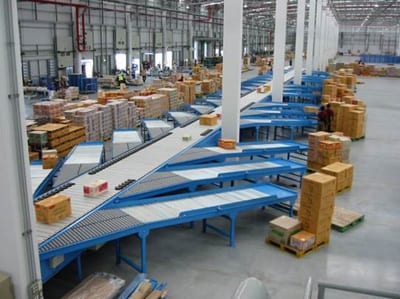
Warehouses and warehouse systems are facing development opportunities.
E-commerce offers opportunities for local satellite warehouses in Europe. Indeed, warehouses located next to major residential areas create potential opportunities for investors to develop online shopping services across Europe. Smaller satellite centers will allow online retailers to increase the number of locations they can serve. While the main center is designed to have a high level of automation to meet higher demands. According to the Centre for Online Retail Research, the proportion of online retail on a retail day is highest in the UK at 12.7%. The Nordic countries are seeing similar growth and are close behind with 10.0% in Germany, 9.1% in Norway and Denmark, 8.7% in France and 8.0% in Sweden. Southern European countries are lagging behind due to limited distribution channels, still heavily using cash payments in transactions, small networks of sales systems and customers often still having to pay shipping costs. “E-commerce is having a profound impact on distribution networks,” said Jim Garland, research analyst at Cordea Savills.
There is no single model that companies are adopting but the general trend is towards large hubs supported by a large number of local satellite distribution centers. Demand for small satellite warehouses located next to large, growing urban areas is particularly strong due to tight real estate supply and the need for more distribution points at the end of the distribution chain. Today’s distribution chains continue to use large warehouses to act as regional or national distribution storage centers: electronics retailers typically need warehouses of at least 500,000 square feet. However, fast deliveries require more delivery points and distribution networks, which will drive demand for smaller satellite warehouses typically around 100,000 square feet with mezzanines and ancillary spaces for packaging with good security, a large number of loading points. These are locations near delivery points, often on the edge of major metropolitan areas, where there is also a large concentration of workers and high demand for shopping.
Note the function of a warehouse:
– Consolidation: When goods/raw materials are imported from many different small and retail sources, the warehouse acts as a gathering point to consolidate into a large shipment, thus gaining advantages in scale when continuing to transport to the factory/market by means of full wagons/trucks/boats.
– Coordination of goods: To meet customers’ orders of many diverse items, the warehouse has the task of separating large shipments, coordinating and combining many different types of goods into a complete order, ensuring that the goods are ready for the sales process. Each order will then be transported by small vehicles to the customer.
– Preservation and storage of goods: Ensure goods are intact in quantity and quality throughout the operation; maximize the use of warehouse area and capacity; take care of and preserve goods in the warehouse.


